October 12nd of 1492. More than two months of navigation after, when, they say, everyone almost lose any hope, the cabin boy Rodrigo de Triana yelled: Land on sight!
Here began the successful history of Castile's conquer of America building an empire that endured until 1898. An empire that, under c.XXI criteria, was quite negative specially for all natives of this new continent (it's named genocide and it's not a joke) but, on the other hand, at least helped to us all catalombians to share at least one language (which was very useful for me when I met the girl that lately became my wife).
Centuries came and someone decided to make this day THE holiday of Spain, which was celebrated all along America, named "Día de la Hispanidad" (Hispanity Day) or "Día de la Raza" (Race Day) (I assume that it's named Columbus Day just in USA). But I must say that this one about "... la Raza" is just the worst idea you may have to name a holiday (if you are not Borat). But it also sounds quite weird for me because there cannot be any pure hispanic not in America (creole by definition) and not in Iberian peninsula (like in my case). Just remind that Iberian Peninsula has been invaded by any empire on hand (just like being the most famous brothel of two entire continents)
But it's not just its name what upsets me about this holiday. It's the idea of let it be THE BIG holiday of Spain. I mean... I accept that we catalans celebrate celebrate a BIG defeat (which is not, no way, as I told last September 11th).
Just check another blog of mine with a post where I suggested some other dates for this holiday:
Ahir no va ser la meva festa (ca)
And it's even surrealist that all TV stations follow COMPLETELY this silly militar parade (is it necessary, having a specific day for it called "Día de las Fuerzas Armadas"?) that even PP leader got caught telling what LOT of people think: it's booooring.
Just check this year's parade:
But, on the other hand, they just ignore Vivamerica (es) festival, which is the best expression of the best side of all this story (yes, the bright one, don't talk today about genocide, cruelty and conquer)
Es mostren els missatges amb l'etiqueta de comentaris national day. Mostrar tots els missatges
Es mostren els missatges amb l'etiqueta de comentaris national day. Mostrar tots els missatges
diumenge, 26 d’octubre del 2008


dimecres, 10 de setembre del 2008
9/11, National day of Catalonia


This not blog about politics, colombian nor catalonian. But in days like this I cannot and I don't want to avoid this issues. Just in days like this.
Out of Catalonia, the september 11th is the day that Al-Qaeda hit the Twin Towers at New York. Others may recall the rise to the power of the tyrant Augusto Pinochet at Chile. But no one will understand why we catalans celebrate our most important holiday.
Today, nearly 300 years ago (1714), the troops of Philip V of Bourbon (direct ancestor of Spain's current king) conquered the city of Barcelona after months of siege, after years of war. This day ended 7 centuries of Catalonia as an independent country or, at least, as a country with its own laws.
This day it also started or long way to our people's victory: the survival of Catalonia as a culture, as a nation.
Yes, I said nation. Just take a look at our history.
I'm pretty sure that the spanish history you may studied at school (if any) told you about some kind of uniform country born with the marriage between Elisabeth of Castile and Ferdinand of Aragon the year 1492. There are even who moves Spain's birth even further in the past. The year 722, at the Battle of Covadonga, all cristian kingnoms of the Iberic Peninsula allied against the muslims showing, they say, a "unity of universal destiny". Just a way to say that all these independent kingdoms knew that some day in the future they will build something called Spain.
But there's another version of the history.
After the romanitation of the Iberic's Republic, when the name was born (Hispania), and centuries of muslim domination, some cristian kingdoms and counties appeared. They didn't make war only against muslims, but also between them.
These kingdoms, by territorial conquer and dinastic marriages, arrived to the Renaissance in three blocks:
- Kigndom of Portugal
- Kigndom of Castile
- Crown of Aragon (also known as catalonian-aragonese)
This third country was sort of confederation where each territory had its own laws:
- Kingdom of Aragon
- Princedom of Catalonia
- Kingdom of Valencia
- Kingdom of Mallorca
So this famous royal marriage of year 1492 unified both the Kingdom of Catalonia and the Catalano-aragonese Crown. But during centuries each territory kept their own laws.
During centuries, until year 1701 when the War of the Spanish Succession. It was a conflict all around Europe and America to get who had to the heir of Spain's throne (and all its territories all around the world): Philip V of Bourbon or Charles III of Austria. The Catalano-aragonese Crown joined Charles' side and just check who is the current king of Spain (John Charles I of Bourbon) to know who won the war.
So, this September 11th of 1714 Philip V of Bourbon was free to charge us all "conquer right" and repression with its main example in Nova Planta's decree.
:
- He imposed us all laws of Castile ignoring all laws and traditions of the territory.
- He imposed us the castillian (AKA spanish) as the only valid language, letting catalan to a dangerous situation that even today, centuries after that, we're trying to mend.
- They created new taxes just to punish our people.
- Generalitat (Government of Catalonia), Consell de Cent (council of the hundred), Junta de Braços, all our institutions were banished.
But here's where our victory starts. Because today, even all spanish efforts to assimilate us, we still are catalonians, we still feel like a nation. We still fight for our stolen rights.
This is what we celebrate today: the will of our people to recover our liberty.
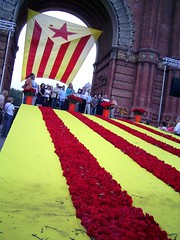
Visca Catalunya Lliure!
dissabte, 19 de juliol del 2008
Bicentenary flowers of liberty


 Oneris Rico
 They tell that, almost 200 years ago, Royal Comissioner’s Antonio Villavicencio, was coming to Santa Fe (of Bogota). Two Creoles that were preparing its reception asked a spaniard for a vase. This spaniard denied and they all started to argue, and then to fight.
It seems that the ambient was quite hot these days, because they were planning a revolt just taking advantage from this visit. So they end to the palace shouting "¡Viva el rey Fernando VII y abajo el mal gobierno!" (Hail to the kind Ferdinand VII and down with the bad goverment!). Some leaders as José Acevedo y Gómez, José María Carbonell and Camilo Torres took the initiative and got to the constitution of a government made with creoles, but with the viceroy in charge.
They were proclaming their independence from Spain.
Then came the time of the “Patria Boba” (Silly Homeland) and the Spanish re-conquer, once the king Ferdinand VII recovered his crown and Spain was no more invaded by french troops, the year 1815. But 4 years after came Simón Bolívar and these American lands recovered its liberty, but this is another story.
Este es el motivo de tanta fiesta y baile que hoy reunirá a todos los que sientan como propia la bandera tricolor o, al menos, tenga ganas de fiesta y jarana.
But there are some things I cannot avoid mentoning, as a catalan.
There’s first the historical context, because just at the very same time that these future colombians were fighting for a vase we were here shooting at Napoleon’s soldiers. IT’s really convinient to have your enemy’s troops occupied at the other side of the world just when you decide to revolt. But just remind that when Bolivar came, the thing was just definitive with no excuse for spaniards’ defeat.

Ferdinard VII
I also noticed something familiar on the slogans: this one about “Viva el rey Fernando VII” was a quite revolutionary one. These days the official king of Spain was Joseph Bonaparte (AKA Pepe Botella, Joe Bottle) imposed by his brother Napoleon, so generous with his family that gave complete countries to his brothers.
This shout was also some time before at Manresa, at the historycal “Burn of the sealed papers” when the made quite a bonfire with the documents from the French authorities of Barcelona shouting "Visca lo rei Ferran" (Hail to the king Ferdinand) using his name as a symbol against their oppressors: the French. Just a pity that, once he recovered his crown, he became a completely absolutist king. All the people that fought for him got pretty surprised (or executed).

Harvesters’ revolt , Barcelona, 1640
And this one of “abajo el mal gobierno” reminds me a lot this one of "Visca la terra! Muiren los traïdors! Muira el mal govern!" (¡Hail to the land! ¡Death to the traitorous! ¡Death to the bad government!) when the harvesters got to the palace this year of 1640 in one of the most legendary feats of my homeland’s history (they also killed the viceroy, by the way)
 José María Carbonell Luis Angel Arango’s library
But the last one is the evident catalan origin of one of these leaders: José María Carbonell.

Carbonell’s coat of armsArmoria.info
Carbonell es un apellido de origen catalán compartido por 4957 catalanes y otros 11509 en el resto del Estado Español (incluyendo a los del aceite de oliva) y, a pesar de que José María Carbonell quizás no supiera nada de Cataluña o a saber cuál sería el último catalán de sus ancestros, no deja de ser sorprendente el encontrar un mon(t)serratismo en la mismísima cuna de la patria de mi señora y mi hija.
Carbonell is a catalan surname shared by 4957 catalans and other 11509 citizens of Spain (these ones of the olive’s oil included (es)). Yes, I know, maybe he didn’t know a single word about Catalonia or who knows who was the last catalan of his ancestors, but it’s just surprising finding such a mon(t)serratism at the very birth of my wife’s and daughter’s homeland.
So finally, fellow colombians, Viva Colombia!
More information:
Museo 20 de Julio (es) where they say all this happened:
View Larger Map
El Florero de Llorente (es) What it happened.
Subscriure's a:
Missatges (Atom)